Thursday, 1 July 2010

Further musings...


Dr Bell's clinical suspicions that I had contracted Dengue Fever were confirmed by the blood test result that had been sent to Port-au-Prince. Although Dengue is known to be in Haiti Dr Bell claims this was the first case he had seen here, as it appears most Haitians have some form of natural immunity. (Lucky them!) Although I felt as though I had lost quite a lot in the 2 weeks I was unwell, I am also aware of how much I gained as well.


I lost about 1 stone 4 lbs in weight (that's just over 8kg), but that will do me no harm at all!

I also seem to have lost some time - it's hard to explain but the memories I have of the time are very hazy.
What is harder to accept is that I seem to have lost a lot of energy: on several occasions I thought I was on the mend, and got up, washed and dressed, fully expecting to go the hospital to try and work, only to find I couldn't eat any breakfast, and then couldn't even stay upright and had to lie down.

But what I have gained is priceless, and probably beyond words: without meaning to I have obviously been a worry to those at home and those in Haiti - but Robyn had put herself way over the top in my care. The prayers of the Haitian church, as well as those from home, New Zealand and even further afield have been very humbling. The love and care of Cilotte - a Haitian nurse (whose injection technique I can recommend) and of Bernadette - Robyn's cook/housekeeper were so gentle. Bernadette arrived one day and just started praying - in Creole - and Robyn said that she simply felt that is what Jesus wanted her to do.
A good friend from England wrote to me, she said: "There are more ways than one to be a gift. Vulnerability allows others, usually labelled 'the needy', to serve you. Will pray that God uses this reversal for good." I join my prayers to that one.

And now for some more musings and observations - which may find their way onto this blog before it's wound up.
Shopping in Cap Haitian is an exciting adventure. Most of our food is bought by Bernadette from the market. And the market has everything. Chickens are bought live - from vendors who have them on poles - and it is common to see them being brought home on the motorcycles, on what is a one-way journey for them. At least we can know our meat is fresh.
Fruit and vegetables are in abundance, and the avocados and papaya (with lime juice) was a breakfast treat. A lot of eggs are eaten here (well I'll be bound) and they are sold hard-boiled along the streets.
There was one supermarket which for convenience (not for price) we used to visit. It is called the Kokyage and visiting it was a mixed experience. There are not many supermarkets in the UK or NZ that have the benefit of an armed guard at the door. But this supermarket is not alone in this - all the banks, and many other businesses have it as well - guards toting what can only be described as pump-action shotguns but without the butt - more like enormous pistols.
And although I always spoke with the guard, and he became very friendly, it is sobering to imagine what might happen...
The Kokyage is well air-conditioned, which made it a welcome break on the walk from the hospital, but outside is surrounded by children begging. Some of whom are dressed and suited for the part - others look a little too well fed. Robyn says that Haitians are very good actors, and these kids certainly know how to turn on the pathos. "I'm hungry" "Give me a dollar" "Grand-gout" (which is Haitian for hungry). They have even followed us the half a mile or so home with hands outstretched. Robyn advised us not to give, and once we had this in mind, and it was recognised, we were left alone a little. I tried to turn the tables once - and said to them to give me a dollar - and they did give me a Haitian coin (quickly returned!)
Begging does seem to be a fact of life here. It was not uncommon - in fact usual - for people to approach us on the streets because we are white (blanc) and to ask for money. Sometimes it verged on the aggressive. And being rich, it doesn't come easy to be remined of it by people who really do have nothing. But at other times it is a feature of even those we are working with - asking if we can give them money for this project or that item of need. But if we start where do we end? And what is the right judgement - is a lamp-bulb for a projector more important than the work of a pastor? It was very tempting to remind the askers that we are only white, but we are not God. I havn't fully resolved that issue by any means.
Leaving the hospital was very moving.
I managed enough energy to go in for the last 2 days. On the last day I was helping the junior anaesthetist with some spinals, and the anaesthetic nurses had an exam. But they all came into the office having post-poned the exam for an hour and made some very generous gifts - for me and for Lorraine, and the request that I come back. So for someone who has felt so useless over the last 2 weeks it was an emotional moment.
I have various other musings and events, and more importantly people to describe - but that will be for later. I am writing this from the Dominican Republic - and have just bade farewell to Ross and Kim. Fiona arrives later today, and I fly to New York tomorrow.

Sunday, 27 June 2010

Port-au-Prince


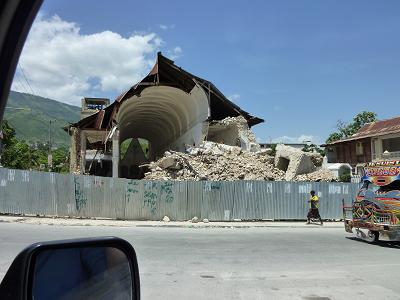
On January 12 at about 4.50 in the afternoon “the” earthquake hit Port-au-Prince in the south of Haiti.

Officialdom records over 300,000 people having been killed, and the figure is more likely to be in the region of 500,000. The majority being buried in mass graves just outside the city. As in any disaster there are the, perhaps, expected stories of heroism and humanity, but also the rather shabbier accounts of self-interest and human exploitation.

Jean-Claude, Robyn and I flew to Port-au-Prince on a Saturday morning, as ostensibly this was the reason for our being in Haiti in the first place. The domestic and international terminal at Cap Haitien Airport is about 30 minutes from the centre of the city, and to get there involves negotiating the usual traffic obstacles – potholes, other drivers, pedestrians, lorries, tap-taps and a mass of motorcycles. We cross over the river, and the bridge is slowly returning to being a major trading area, as the memory of the earthquake slowly fades and with it the fear of a local recurrence.

At the airport our hand-luggage is x-rayed in common with anywhere else in the world, but the loud “beep” generated as we walked through the scanner seemed to generate scant interest.

Waiting in the “departure” area were several nuns – although Roman their precise orders were not obvious; an Episcopal Bishop and assorted other travellers. Flights were going to Port-au-Prince, The Turks and Caicos, and the Dominican Republic. Our plane could seat about 25, and was piloted by 2 pilots from the Dominican Republic. The flight took about 30 minutes, and we had clear views over the Haitian country, and it appears very green, and largely unpopulated.

Port-au-Prince from the air is at once much bigger than Cap Haitien, and it takes a while for the evidence of the earthquake to become apparent.

We are met by Spentz, who with his family have lived in Port for the last 8 years. He is a business man, and is clearly doing very well. He drove us around the city, and included areas of all degrees of prosperity, as nowhere was exempted from the damage. As he drove it was the almost casual comments that were the most disturbing:

“this was a school – 1300 children were killed here”

“just here a girl was saved after having her legs amputated, but the remaining 12 members of the family all died.”

“this was a bank – all the employees got out of the earthquake, but were killed by a gas explosion”

“on the day after the earthquake you couldn’t walk or drive down this street because of the masses of bodies lying on the road.”

All over the city there are piles and piles of rubble, a very little bit of salvage is being attempted – in the whole of the city we saw only one bull-dozer. There are a lot of tents, and rows and rows of “porta-loos” many of which are just outside the presidential palace. In the more prosperous areas there are more concerted attempts at salvage, but still people are living in tents in the garden.

Spentz was in his car when the earthquake struck – and tried to get out of it, but was not able. His children were at home with his sister, and all of them were unharmed. During the first night there were stories of extreme courage and acts of selflessness – whole communities working together to get people out, and when it was too dark and too late, there breaking out spontaneous services of prayer and hymn singing. But there are darker aspects too – the daughter of one of Robyn’s friends was trapped with a friend. The friend was freed, but because there wasn’t enough money to pay the extracting team her friend was left. Thousands of Haitian dollars exchanged hands in the immediate aftermath of the event.

Spentz was able to voice some of his concerns – and although he is a long way from being a politician it is people like him who are needed for the country – people who can stand back, and look away from self-interest, people who can recognise the faults and lessons to be learned from other countries, and who have a passion for the nation. Interestingly he is increasingly convinced for the need for very firm government – even the possibility of a dictatorship – to start the country back onto the long road of economic and social reform.

If we looked beyond the obvious signs of building destruction, it was very odd to see signs of “normal” life going on as before. On every street there were markets and stalls, as people try to eke out a living. Stalls as varied as sweets, second hand clothes, new suits, and car parts literally in front of piles of rubble the height of a single story building.

It became mind-numbing after a couple of hours, and the return flight became increasingly attractive. I think visiting the area was very important, if somewhat unpleasant, and even verging on the voyeuristic. But perhaps the most disturbing aspect of the visit was watching the reaction of Haitians back in Cap Haitien as they looked at the photographs we had taken: despite having lived with the reality of the events for the last 6 months, seeing them in silent tears was just too much.

Monday, 21 June 2010

From giving to receiving...

When I had first begun to grasp the reality behind the vision/plan that Robyn had for this mission - to be a "Gift" from the church to the people of Cap Hatien, it really hit home, and made what we were doing - or for most of the time trying to do - make sense. So to find myself unable to be that "gift" for several days has been really hard, as well as the physically reality of being knocked right off my feet.

For the best of intentions this entry is an intensely personal one - as I haven't really been able to experience anyone else's world for the last few days.

With hindsight I think I had been feeling unwell for a couple of days - low grade headache, a bit dizzy, not much appetite. On the Wednesday it had been quiet in theatre, and so we had finished early, and we had arranged to go out for a meal with 8 of Robyn's Haitian friends to a local restaurant.
As we were walking to the place I remember thinking quite clearly how I must be adapting to the heat situation because I had stopped sweating, and in fact was feeling a little cold - I kept getting covered in goose-bumps.

(The little girl pictured is Jamily - oldest daughter of JP and Pauline who came to eat with us that night.)

That night was a rather rough one - I shivered and shivered, don't think it was quite a rigor; was dry retching a few times, then slept for a couple of hours, waking up dripping with sweat, and feeling as weak as a kitten.
I cried off work, and eventually went for a blood test at one of the private laboratories that flourish in the town. Robyn suggested testing for malaria, typhoid and a full blood count. She found a thermometer and my temperature was 39.7c (103f). As I was feeling worse all the time she took me to her doctor - who very kindly interrupted the World Cup to see me (and believe me the World Cup is taken very seriously over here.)
Dr Yvan Bell is Haitian, and very gentle and caring. He fully examined me, ordered samples (you can guess) and some more blood tests.
He wondered about Dengue Fever - because I did have some odd little red spots that I thought were insect related.
The test results were inconclusive on every front:
  • I had been assiduous in taking anti-malarials, so if it was malaria the parasite might not have shown up;
  • there is no specific test for Dengue fever (so I understand)
  • and the samples were negative for Shigella, Amoeba, Giardia or Salmonella.
However I was feeling even worse - dry retching every few minutes, having very weird dreams and thoughts - weirder than usual. And by the next day Robyn insisted on a home visit. IV fluids next.
The system here is different to the UK - in case anyone has other ideas. Your friends and family go and buy the equipment and it is set up by you. Robyn duly appeared with a black bag containing some litres of IV fluid, giving sets and a cannula.
Given that we were me, a surgeon, and an ex-nurse there had to be a decision as to who was going to site the needle - I won!
The fluids and anti-emetics (anti-sickness) drugs began to ease things, and after a few days I am starting to feel slightly more normal again. Though I am still completely off any thought of food - which as most of you know is totally unlike me.

What has been so very humbling has been both the care given to me, and the love shown. It's not easy for me to receive, but I just had no choice. Robyn spent a lot of time just sitting with me. On the Saturday when she and the others went to Port-au-Prince Cillotte spent the whole day with me, just sitting in my bedroom reading, and when I was retching and retching she would rub my back and stomach, and sponge me down. She and Bernadette even gave me a bed-bath (very professionally - all modesty preserved, though by then I was past caring).
She also gave me the anti-emetic injections as often as needed.
Bernadette has been very caring too - coming in on Sunday so that I would not be by myself for any time. Such a sense of love and care being given by a people who have so little materially, it has been quite emotional.
I also found myself getting irrationally annoyed (and even angry) about little things - as I have said the water pump is intermittent here. And so to have to have someone go down to the well for water for washing, and for the toilet etc made me so cross when all it would take is for someone to fix the pump. Then I had to think of the tent cities in Port, or the shacks all along the roads, in everyone of which there might be someone just like me - feeling really ill, and no hope of water. Forgive me my self-pity Lord.

Saw Dr Bell again today who agrees that I am on the mend - just got to try and find some more energy. Hopefully next blog will be far less self-centred.

Friday, 18 June 2010

fevers...

Regretfully the blog is temporarily suspended due to a attack of either malaria or dengue fever. (Wikipedia has excellent accounts of both).
More will follow later except to say now that it revealed itself as a fever hovering around 40c and the most draining feelings of nausea and vomiting.
I could not be better looked after - room mate is Ross, who as a colo-rectal surgeon (but more likely as a father of 6 and grandfather of 6) is totally un-phased by all things connected to bodily functions.
And Robyn - once a nurse, always a nurse - who has been wonderful.
Many thanks for those who are praying for me - it not surprisingly makes a difference.

Wednesday, 16 June 2010

A view from the roof top...


The house in which we are living is tall and narrow. Enoch rents the house, and for a few weeks lived there with a friend. The friend now lives elsewhere, but as the rent is paid in advance - I think on an annual basis - Enoch has the house all to himself.
The previous tenant was a missionary with Medical Ambassadors - and who had made a lot of contacts with the locals, many of whom live close to, or on the street. In making these friendships she paid a price in material matters as she "lost" computers, money, books and more.
Just the other day there was a local boy knocking on the gate - he looked well-fed and clothed - and he said that he used to get peanut butter sandwiches from a white person who used to live here.
There are big iron gates or doors opening onto the street, and space for a car - or "machine" in Creole.
On the ground floor are some small rooms which are usually uninhabited - one of them even had a piano in it, though it had totally lost its tune! But at the moment Enoch is living in one of them. He effectively has an en-suite - for when the water is running.
The main "living area" in on the first floor - a balcony, a sitting/dining room (where the TV is) a kitchen adjoining the toilet/shower, and a sort of hallway with stairs going up and down: down to Enoch's sleeping area, and up to where Ross and I pass the night.
The upstairs room is big and open - big enough for 2 double beds (and a single bed for later), a computer desk and an outside balcony which is pictured. I have tried to show how high the balcony is, and also to what is behind us - a fairly steep cliff with some scrubby trees, and very often a number of goats. During the night the goats can sometimes be heard scrabbling up the cliffs by both their bleating and by the mini-landslides causes.
I say "mini" because just 2 doors away - and again pictured was a small primary school. A few days after the earthquake in January there was an unrelated tragedy at the school: a rock broke away from the cliff and landed on the school killing four of the pupils. Just one more tragedy amongst so much. The school is still closed and the buildings un-occupied.

The upstairs balcony has on it, as you might be able to make out - two water tanks, which are filled by the menacing pump (when it is working) and there is also an impressive looking satellite aerial - except that is useless in terms of TV picture, and the internet (which also uses it) is highly dependent on the weather.
It gives a glimpse of the sea, and is great for seeing the sunrise.
You might also be able to see piles of washing all over the place. Bernadette does our washing, and that of Robyn, Dale and Kim. And it is all hand-washed, then ironed (until just recently all the ironing was done by a charcoal iron - now it's electric).
The process is laborious, but done well. The water is drawn from the well, the clothes are wetted, soaped, scrubbed and rubbed on the concrete floor, rinsed, and rinsed again, vigorously wrung out (there is no "delicates" option) and brought up to dry on the balcony. This is a process repeated all over Haiti - except that the drying is just as likely to be done on the roof of the house, or on a hedge of cactus plants.
Many of the Haitians take a real pride in their appearance, and to see the smart. crisp uniforms on the school children, and the extent to which they dress up for church, it is hard to guess the difficult living conditions so many have to live in.

Bernadette is very good at her job, and the clothes service is fantastic.


Tuesday, 15 June 2010

bits and pieces


A couple of photos to try and support my claim that I have been in theatre most days! And that the sun-tan has come from incidental exposure rather than anything planned. I am pictured with Drs Nadine Compet and Jo-Ann Jean-Louis. They are both residents - Nadine has 2 years experience and Jo-Ann 2 weeks! In the other picture is Dr Carmel Leconte - chief Anaesthetist, and only permanent member of the anaesthetic staff. She originally came from Port-au-Prince, but after her marriage she came to the north of the country. Her husband is the head of Obstetrics and Gynaecology at St Justinien.
The case loads are very different from the UK - although there are General Surgery, Orthopaedics, Urology, Oral Surgery, Obstetrics and Gynaecology lists - the content of them is quite different, and the choice of surgery also very different.
There have been a lot of prostatectomies done here - but none have been done endoscopically, all open and (I think) transvesical in approach.
There have been a lot of fractured femurs - motor-bike, football, falling out of cars - but there is no X-ray facility in theatre, so they are all plated (rather than rodded) and I assume get a check x-ray some time later.
70% of the cases are done under spinal anaesthesia - including children as young as 12. The only failed spinal I have seen was one of mine - I did wonder why the anaesthetic nurse asked me to do the spinal as they are usually very keen on doing the job themselves. This patient was 17 years old, and coming for second skin graft to his foot - (he is epileptic and fell into a fire). All was going well as I sat him forward, cleaned his back, but as I started to feel for the space on his back to place the needle he virtually took off out of the table, and that was almost before I had got the needle out of the tray! Despite being almost too forcibly held, he was not going to sit still and I went quickly for a general anaesthetic.
Nadine is very keen to learn and one prostate list all the cases were done using epidural anaesthetic - as she was keen to learn that technique.
One thing I have discovered about teaching is that it has resurrected skills I may once have had but use rarely now. So keen was Nadine to do brachial plexus block, that she persuaded me to teach her site one for a prolonged tendon repair - and it was the only method of anaesthetic necessary, and it worked so well that then every possible time a nerve could be used the request has come to try it out. And so I have to quickly remember how to do (and then teach) femoral and sciatic nerve blocks. And I have been surprisingly impressed with how effective they can be.

Away from theatre, and back to home life. There had been a consistent run of power cuts from about 4.00am to 9.00am. This had been going on for about a week, and given that there had to be cuts, it wasn't a bad time to have them.
But then the pattern changed a little - and moved to midnight to 4.00 am and no power, which was rather more difficult chiefly because of no fans.
The reason we think is because of the World Cup. Haitians in general are passionate about football, and so the World Cup has been a big thing here. There are broadly speaking 2 big divisions: those who follow Brazil, and those who follow Argentina. And it is not uncommon to see the flags of the 2 countries on cars and motor-bikes, and also to see the team strip being worn. The change in power cuts we think is so that the morning matches can be seen.

When the matches are on - life is distinctly quieter. Today Brazil were playing Korea, and a number of the physio patients didn't turn up, and the theatre lists finished early!
But for us the match of the day was New Zealand's opening encounter with Slovakia. That was scheduled for 6.30am our time - which is fine as I generally get up at about 5.00am.
The television at Enoch's has seen better days. To turn it on or off requires a pen to be shoved into a hole (crude but effective), and the picture is pretty shaky and broken. It makes following the ball tricky, but possible - just. Ross improved the picture a little by using some surgical dressing plaster he had to secure the aerial slightly more firmly into its' socket.
We were eating our breakfast to the match commentary - given in Creole, and by 2 commentators who are also in Haiti, just watching the match as we are. Every now and then, the oral commentary is interrupted by a voice from the sponsors - Mattato Supermarket, urging us to shop there and nowhere else.
Just as it seemed Slovakia were to score - the power failed and we resorted to the internet, only to find that the ball was kept out by the NZ goalie.
Power was resumed after five minutes, and we had the misfortune to see NZ go a goal down, but then with seconds left - to equalise. Much shouting from the dining room in Enoch's house!
It seemed to make the day go quite well.

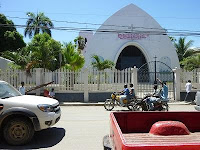
Two photos to finish with - the Episcopal church seen from the front;
and the interior of Robyn's church taken on a weekday. Most of the flowers have been removed for cleaning, but a few have been left out. This in no way gives a sense of the people who are there on a Sunday, nor either of the attendance during the week. I came in for a moments prayer, and all over the building there were individuals or couples either sitting quietly or reading the bible. Clearly in a country which has so very little in material and other resources there is a spiritual hunger that is being met.


Sunday, 13 June 2010

Sundays and other thoughts...

Sundays are fast becoming my favourite day in Haiti. Which is a bit of a confession as on Sundays we generally don't go to the hospital, or look into theatre. The day starts early. Up before sunrise - at round about 4.30 am, shower or wash, depending on the water situation - further confessions: I usually pray for a shower! But without becoming too detailed it is amazing how little water it takes to wash body and hair. (And not wanting to waste the water - it goes into the toilet cistern.)
If I've remembered - and by now on Sunday three there should be no excuse - the coffee left in the fridge can be drunk iced, and we get dressed up for church. I stick to short-sleeved clerical shirt and long trousers with socks and shoes; though many Haitians will come with vest, shirt, tie, suit trousers and jacket, and highly polished black shoes. (How they keep them that way is beyond me - please note there is a lot of dust in Cap Haitien.)
We intend to get to church by 5.30 in order to get a seat in the main auditorium. The service is finished in just over 2 hours, and we tend to leave during the last hymn in order to get out before the major crush, and more importantly so that Robyn can get away without having to talk to nearly everyone! (It would be an exaggeration, but almost every step feels like it's accompanied by a shout of "Miss Ro, Miss Ro". Robyn is clearly much loved and her return has been noticed by many who have both missed her when she left last year, and those who want to know what she is going to do next... and not a few remind her that they said she would be back!!)
So it usually takes about 15 minutes to get back to the flat. And the final obstacle is the flight of stairs up: Sunday School is held on the floor below Robyn's flat, and climbing up is a feat of ingenuity as children and parents are both coming and going.
After a quick change we headed off to a local hotel for breakfast. The Roi Christoph - named after the infamous self proclaimed King who built the palace we visited yesterday, and who, we are told, also worked at a hotel on the same site before his emancipation and elevation to (or seizing of) the throne.
A great choice of eggs - soft boiled, scrambled, fried, sunnyside up, omelet, or poached; there is a selection of fruit - today was bananas ("fig" in Creole - not to be confused with "banana" which is the cooking banana - or plantain and tastes very like potato to me.) papaya, and mango with a lime juice topping; or there is spaghetti. Everything is accompanied by coffee and bread, and we ate well, in the warm, with breezes from the air and overhead fans, and the anticipation of a swim to follow. Ross and I swam, Dale read (or was it dozed) by the poolside, and it felt very relaxing.
A number of people - Haitians and foreigners - come just to swim, and make a family day of it. There were a few others in the pool, but it was hardly crowded. (Quite amusing when the enormous palm tree next to the pool decided to shed a branch which came down with a loud crashing sound and there was much scurrying away of the family playing around the trunk.)
Unlike the pool at the hotel last Sunday, this one, though older, has much clearer water, even if there is a liberal sprinkling of flowers and leaves on the surface - but they are all fresh and don't mar the enjoyment at all.
The hotel also has a wi-fi system, and a number of people have their laptops out and in use. But we have found the reception to be patchy, and this time didn't bring anything with us.
I got my shoes cleaned. Having asked what the usual rate was from some Haitian's who had just had their's cleaned, and seen that is what they paid, I approached the man. In my best Creole i asked the price, agreed on it and left my shoes. When they were returned - beautifully polished, amazingly the price had doubled! Again in my best Creole I declined to pay, reminded him of the quoted price and he backed down. Off course feeling very small by now I did then give a tip, as the service was cheap by any standard, and we in the developed world have such a higher standard of living.

After a leisurely time of it we had an appointment to keep: we had been invited to the home of Ruben and Jacqueline for a meal.
Ruben was our driver from Santiago to Hiati, and Jacqueline (known by many as "big momma" or "Jaa") his wife live about 30 minutes from the centre of Cap Haitien.
Ruben is a Baptist Pastor - looking after a country church with a number of satellite fellowships. The church is not big enough to support him financially, and so he works as an English and Spanish teacher to supplement things. Jaa is a registered nurse and works in the OMS Mission compound near to where they live.
Jaa, and later Ruben, have been some of Robyn's longest friends. Robyn and Jaa worked together at Vaudreill in Haiti, soon after Robyn got here, setting up a Nurse Training Scheme run by a Mission Society. Ruben was on the scene then - with tailor training and a call to the ministry, he and Jaa were engaged. For their wedding Robyn was their "marenne" - which sounds a bit like a mixture of chief-bridesmaid, god-mother, mentor, supporter, and general all-round supporter to the couple. (Most marriages in Haiti have one, but it is both a role and term that is new to me.)
When Ruben and Jaa had their only son - Rudolph, but known as Babe - from the age of 5 he lived with Robyn in Cap Haitien in order to go to school. Jaa says that Robyn is a second mother to him. (This something Robyn has done for many, many children, and even now we are still being introduced to one of her "boys" - I can remember Babe, Dodley, Pousch - or her "girls" - Santia, Sandra, Kethia, Ruth-Marnie... to name but a few.)
Babe now lives in the USA and is a nurse himself.
Ruben and Jaa have been building their house for the last 17 years - and have lived in it for about 15 of those. It is off the main road, up a hill, and from nearby there are spectacular views of the surrounding plain, with the Citadel (above Sans Souci near Millot) in the distant background.
In the photo the Citadel can just be seen on the ridge just left of centre on a peak.

The house is habitable, but still needs to be finished. It is big, airy and cool - helped by fans. It is surrounded by a big wall with iron gates. There is a fantastic covered patio area where I was able to doze for a few minutes.
There is a charcoal kitchen, and a great meal had been prepared. We were offered salad (washed in treated water!), chicken, pasta, potatoes, deep-fried savoury rice balls, beans and rice, washed down with home-made Lemon and Grenadine juice.
Only three of us from the "team" were able to go out to their house, and the table had been set for three.
It took great persuasion to get Jaa to eat with us. (Ruben was still out working in the churches - this is Sunday!) And although Jaa and Ruben have a couple of church girls living with them now, they wouldn't eat with us either.
We saw the puppies at the back - off-spring from "Wolf" the dog Robyn gave to Ruben and Jaa a few years ago. Wolf's brother "Doggie" now lives with Cilotte - another great friend of Robyn.
(There are a lot of dogs on the streets of Cap Hatien - and they are clearly all related! If you ask a child to draw a generic picture of a dog it would probably look like a Haiten one! The dog in the Simpsons cartoon series
is also clearly a close relative!)
Robyn has kept cats - the last one was a good ratter, so Robyn kept him, until the neighbours killed it, and (I kid you not) ate it.

We drove home dodging the usual frenetic driving of the motorcycles and tap-taps. On the front of just a few were emblazoned - "Psaume 136", "Cadeau Dieu", "Magnificat", and "Jezu Merci", and that combined with "Jehovah Raphe Construction Materiaux" and "Shekinah automobile parts" we needed little reminding of the presence of religion here!